
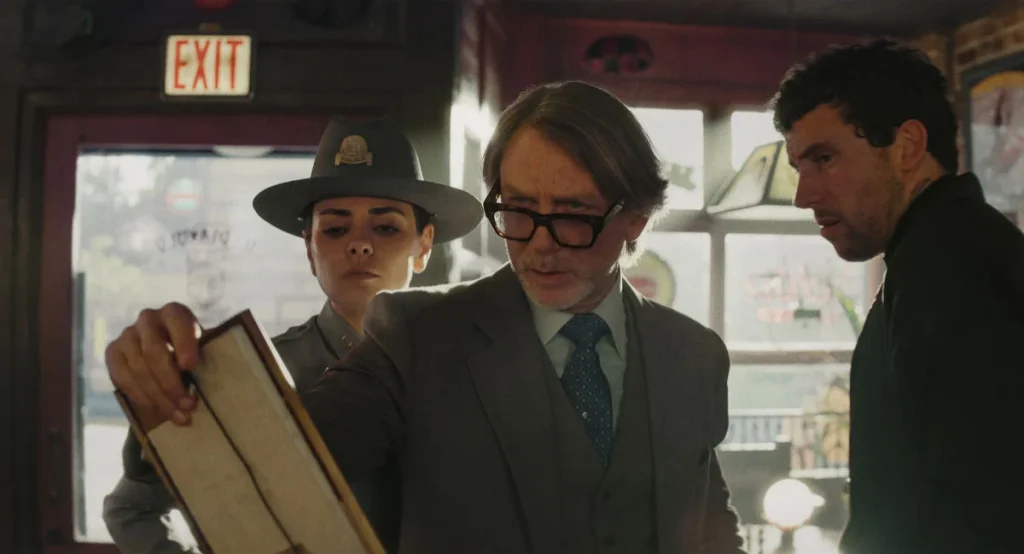
Wake Up Dead Man: A Knives Out Mystery makes it clear that this franchise refuses to stay in one place. It’s not trying to repeat the breezy satire of the first film or the loud spectacle of the second. Instead, Rian Johnson takes us somewhere darker, more reflective, and more personal. This third entry feels grounded and emotionally invested. Mood and character carry the weight here, letting the murder mystery exist as a framework rather than the main attraction. The case is still intriguing, but the real story is how it affects the people at its center.
The story takes place in a small, tight-knit town where the church isn’t just a building it’s the heart of the community. When a sudden, suspicious death shakes the town, Benoit Blanc is called in to investigate. But what starts as a typical whodunit soon becomes entangled with the life of Father Jud, a troubled priest whose faith, past choices, and personal demons are deeply tied to the town’s history. The mystery gradually becomes less about catching a killer and more about uncovering hidden guilt, long-buried secrets, and the moral tension simmering beneath the surface.
Daniel Craig’s Benoit Blanc isn’t the story’s center this time, but he is the anchor that holds everything steady. Craig plays Blanc with his usual charm and precision, leaning into the character’s theatrical cadence and larger-than-life personality. He feels less like a traditional detective and more like a fully realized screen figure instantly recognizable, confident, and endlessly entertaining. His presence stabilizes the narrative, keeping the film lively and grounded even as the focus shifts to Father Jud. Blanc no longer dominates, but he ensures the story never loses its momentum.
That focus belongs firmly to Josh O’Connor, who delivers a performance that anchors the entire movie. As Father Jud, O’Connor is fragile yet volatile, funny yet deeply serious, conflicted yet completely human. He carries the emotional weight of the story with remarkable subtlety. By letting Blanc step back, the film gives Jud’s arc the space it deserves, turning his personal journey into the engine driving the movie forward. Every scene with Jud feels alive, full of tension, emotional stakes, and unpredictability. Watching him navigate this small-town web of secrets is both compelling and emotionally resonant.
The murder mystery itself is still present and clever. Johnson knows how to drop hints and misdirect without being heavy-handed. You might guess some plot points, and that’s part of the fun the film isn’t about shocking the audience for its own sake. Instead, it rewards engagement, showing how everything falls into place and why the resolution matters. Predictability doesn’t feel like a weakness here because the way the story resolves is both satisfying and emotionally grounded.
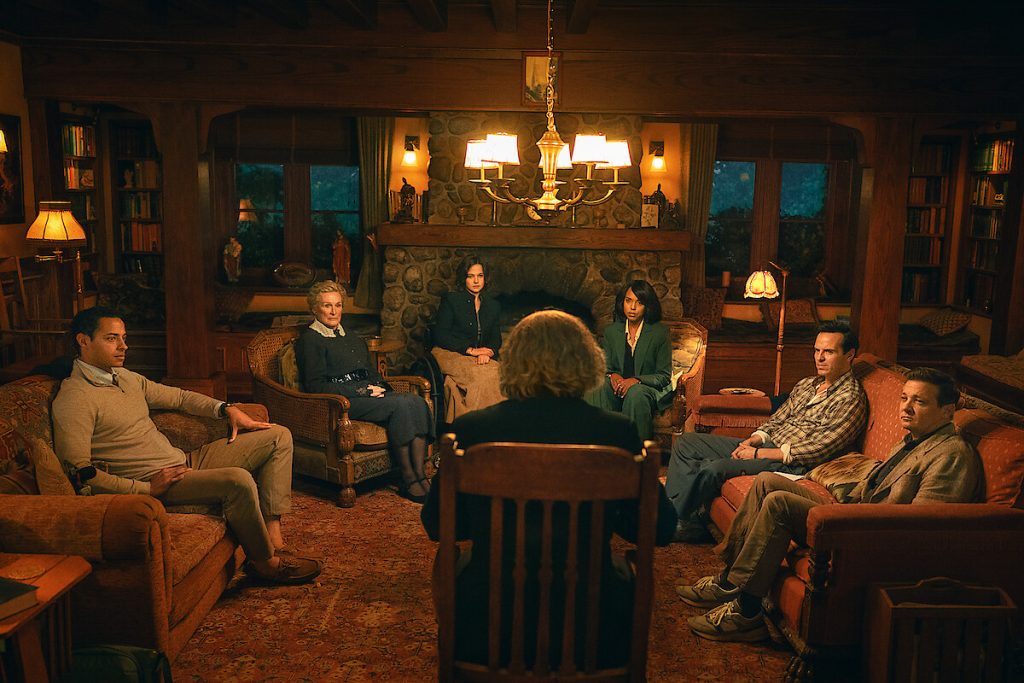
This installment is the most dramatic of the series so far, but it hasn’t abandoned humor. The comedy is character-driven, emerging naturally from dialogue and interactions rather than forced gags. This balance gives the film a unique rhythm, where lighthearted moments coexist with moral tension, internal conflict, and moments of genuine emotional weight. It makes the movie feel alive and relatable, even when the stakes are high.
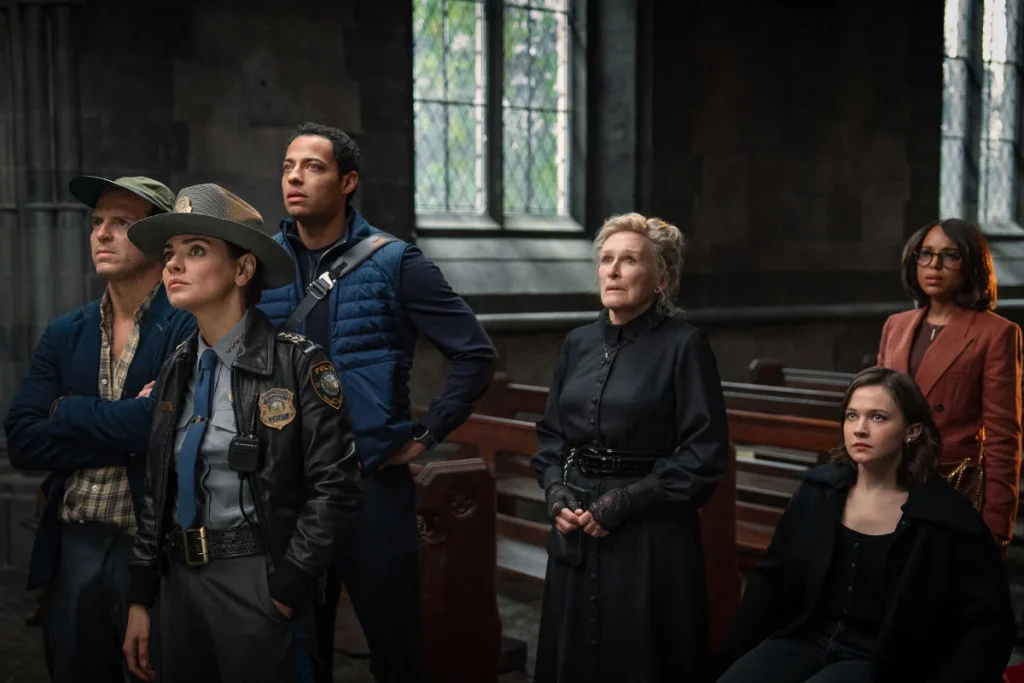
Visually, the film carves out a distinctive identity through subtle gothic touches. These aren’t over-the-top they’re carefully placed to enhance the atmosphere, particularly within the church, which becomes almost a character in itself. Light is used masterfully: sunlight breaks through stained glass and vanishes behind clouds in a way that mirrors the film’s themes of faith, doubt, and moral ambiguity. The cinematography ties everything together, guiding the audience through tonal shifts, balancing warmth and unease, and keeping the town feeling lived-in and significant. The camera rarely calls attention to itself, but its choices consistently enhance the story’s emotional undercurrents.
Rian Johnson’s direction is deliberate and controlled. He spreads hints throughout the narrative, trusting viewers to piece things together without spoon-feeding. The film understands that satisfaction doesn’t have to come from shocking the audience—it can come from clarity and emotional payoff. The ending reflects this philosophy, prioritizing coherence and thematic resolution over surprise.
When compared to the original Knives Out, this film is less tightly structured as a pure puzzle. The first movie was a tightly wound, perfectly constructed mystery. Here, the emphasis shifts to Father Jud’s internal struggle and moral journey. The mystery takes a back seat to character development, which is an intentional choice. It works if you’re invested in mood, emotion, and the characters’ arcs, but it may feel looser for those expecting a more traditional whodunit.
One of the film’s most impressive achievements is how it handles faith. The film approaches belief from a practical, lived-in perspective rather than a poetic, academic, or theatrical one. Faith here isn’t delivered through speeches or heavy symbolism; it’s revealed through behavior, hesitation, failure, and recovery. Through Father Jud, belief becomes something unstable and constantly tested. We see how faith is remembered, questioned, neglected, and reclaimed not as an abstract idea, but as a daily struggle shaped by doubt, guilt, temptation, and responsibility. The film also explores how faith can be lost, whether through rigid ideology or material seduction, without ever stating it outright. These ideas are embedded in the narrative itself, expressed through action and consequence rather than dialogue. This restraint makes the message feel more honest and relatable, and ultimately far more powerful.
Josh Brolin delivers a deliberately rigid performance, leaning into severity rather than warmth. His acting is controlled and forceful, using posture, tone, and restraint to convey authority and moral certainty. It’s an intentionally uncomfortable presence, but a precise one, giving the film a clear point of tension without overplaying the role or pulling focus from the emotional core.
Glenn Close’s performance deserves special attention, who once again proves why she remains one of the most formidable actors of her generation. Close approaches her role with unwavering dedication, delivering work that feels pure, raw, and completely unforced. Regardless of how the broader story unfolds, her commitment never wavers she melts into the character with such conviction that the performance feels lived-in rather than performed. There’s a quiet authority and emotional precision to her presence, the kind that elevates every scene she’s in. It’s a reminder of her mastery of craft and her respect for the material, and it’s difficult to watch her here without feeling she’s more than worthy of serious awards conversation, including a strong case for a Best Supporting Actress nomination.
The tightness of this murder mystery it self, also the supporting cast not having enough room to breathe are where the film falters slightly. Several characters feel underdeveloped, given limited dialogue and little screen time to shine. This is especially noticeable because the actors are so talented. Kerry Washington and Andrew Scott are strong performers, but here they don’t have the material to make a lasting impact. The ensemble feels thinner than it should, which is a shame given the potential for rich, layered interactions. The murder mystery story is a bit predictable and also is less sophisticated than the first Knives Out movie and focusing more on drama caused a minor pacing issue amid the second act.
Even with these shortcomings, Wake Up Dead Man: A Knives Out Mystery is a confident and engaging entry in the franchise. It may not be the sharpest puzzle, but it’s arguably the most emotionally resonant. By focusing on character, atmosphere, and moral complexity, it shows that the Knives Out universe still has new stories to tell. It may step away from some of the familiar comforts, but it does so with purpose, offering a darker, deeper, and ultimately satisfying mystery experience.