
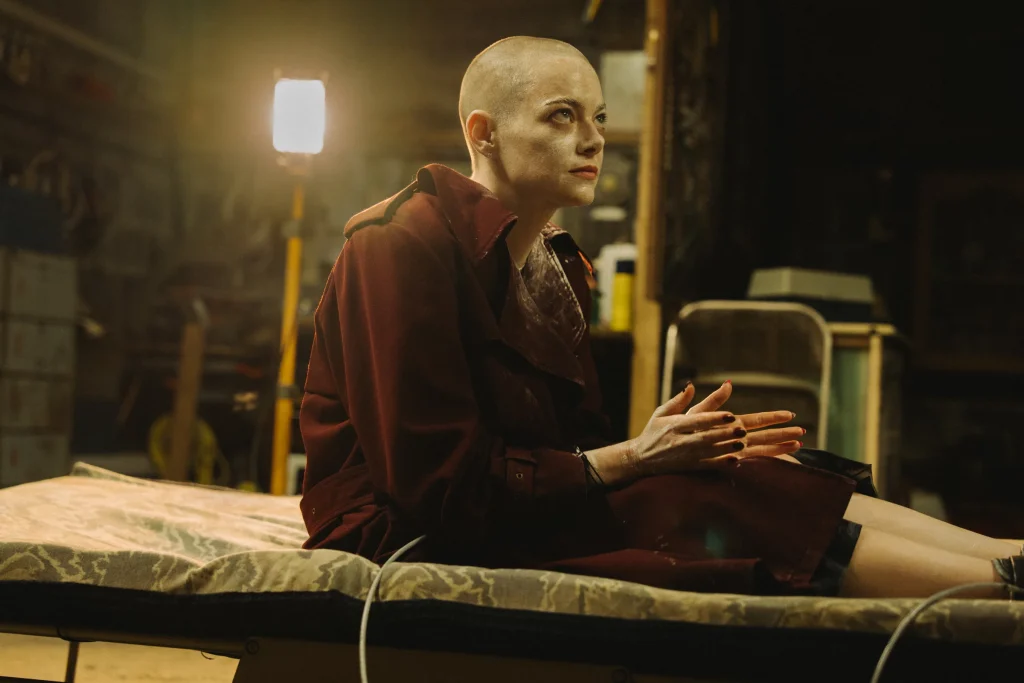
Yorgos Lanthimos’s cinema has always carried a theatrical temperature—composed frames, controlled performances, and a sly, unnerving humor that folds reality into something slightly off-axis. Bugonia doesn’t abandon these signatures, but there’s something new in the air this time. The dystopian undertone that seems to follow Lanthimos wherever he goes regardless of whether he’s in the past, the present, or a surreal in-between feels more rooted in the narrative, not just an aesthetic choice. The texture of the image, the props, the odd bursts of music that initially feel misplaced all start to make sense once the film reveals whose inner frequency we’ve actually been hearing.
The movie starts with a troubled loner “Teddy” played by Jesse Plemons, becomes convinced that an influential businesswoman “Michelle” played by Emma Stone is secretly an alien preparing humanity’s extinction, he teams up with his eccentric cousin “Don” played by Adrian Delbis to “save the planet” the only way they believe possible: by kidnapping her. But as the three collide inside a secluded hideout, the line between paranoia and truth blurs into something far stranger.
What begins as a chaotic conspiracy spirals into a darkly funny, unsettling, and unexpectedly human mystery one where every motive is suspect, every belief is fragile, and the fate of the world might hinge on the last person you’d trust with it.
The story begins with a pair of mirrored morning routines two people waking up on the same planet but in different realities, their days unfolding in parallel rhythms that quietly tease the film’s central tension. Lanthimos stages these openings not as gimmicks, but as emotional coordinates. They outline the differences and faint similarities between two characters whose lives will collide in ways neither entirely understands. And although Bugonia draws its bones from Saving the Green Planet, this adaptation is unmistakably his: the gliding camera that trails behind bodies, the sideways drifts next to vehicles, the mosaic of angles that seem to reframe reality every few minutes. Even without seeing the original, you can feel how he reshapes it through his own cinematic fingerprint—texture, rhythm, symbolism, and an instinct for the absurd.
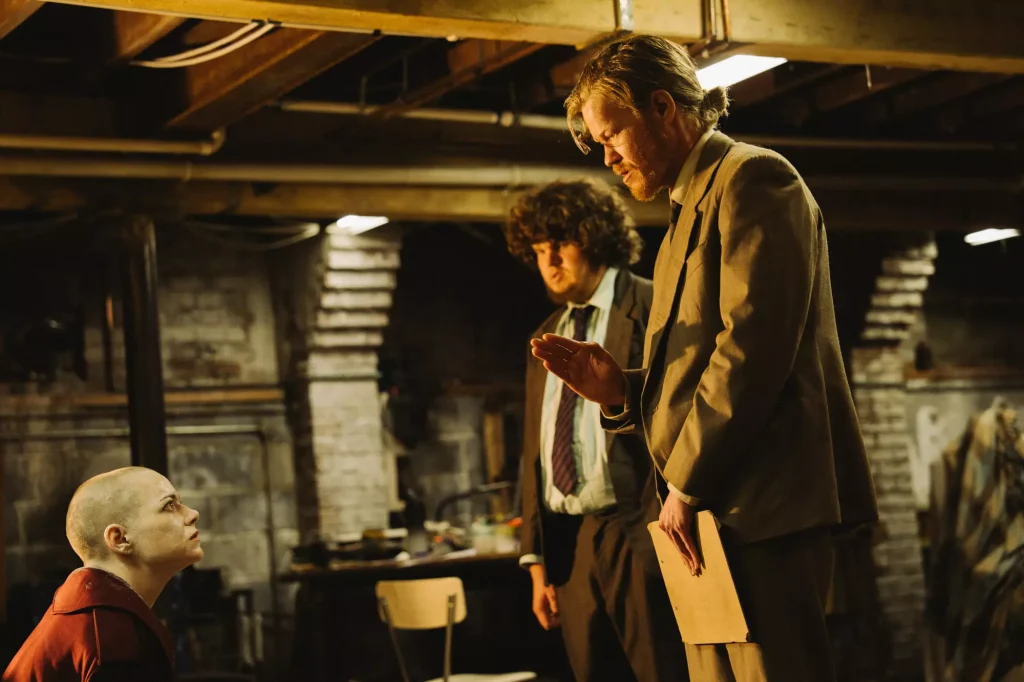
What stands out most is the film’s tone. Despite dealing with paranoia, belief systems, and the spiraling logic of conspiracy thinking, Bugonia carries a surprisingly sharp humor. It isn’t a comedy by any stretch, but the moments of irony an awkward pause, an eccentric reaction, the peculiar confidence with which characters cling to outrageous ideas—land with a smirk. Lanthimos allows the humor to bubble gently inside the tension, which gives the film a strange buoyancy. It’s a slow burn narratively, but never a slow film; there’s too much movement, too much curiosity in the camera, too much forward momentum in the performances for it to drag.
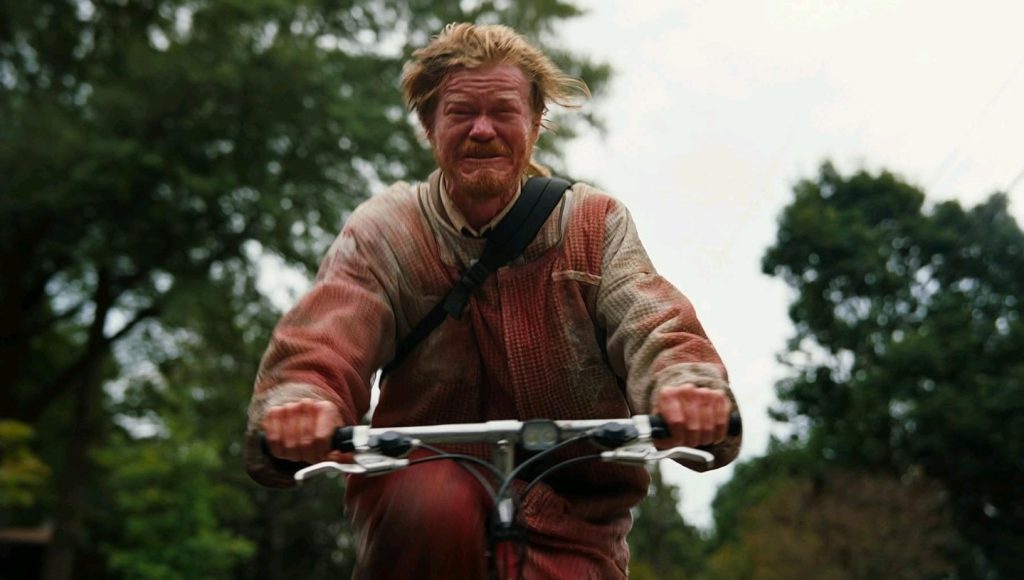
Emma Stone’s character is introduced through a situation that films usually play with broad strokes and clichés, but she approaches it and Lanthimos stages it with an intelligence that sidesteps all the expected moves. Stone brings a precision that fits perfectly into this world, making every shift in expression or decision feel fused to the character rather than to plot necessity. Jesse Plemons, however, is the film’s force. His performance as Teddy is layered with contradictions: conviction, vulnerability, fear, hope. What begins as a character who seems easy to define becomes, through Plemons’s control and quiet ferocity, someone heartbreakingly complex. This might be his finest performance yet a complete embodiment rather than an interpretation. Aiden Delbis, playing Don, gives one of those deceptively difficult performances that could easily tilt toward exaggeration or sentimentality. Instead, he threads an exact balance, crafting a character whose condition is neither exploited nor softened, just lived.
The screenplay by SethReiss, one of the writers behind The Menu, is restrained, especially in its dialogue. It’s almost surprising given how verbally playful The Menu was. But the connection between the two films isn’t in the writing style it’s in the fascination with belief taken to extremes. Where The Menu dissected the cult of exclusivity, Bugonia examines something more fragile and raw: the human need to find meaning when the world feels unbearable. Reiss and Lanthimos together lean into that desperation with a tone that is less satirical, more melancholic.
And this is where the movie’s title quietly coils its meaning around the story. Bugonia, in ancient mythology, is the act of creating bees from the carcass of a sacrificed ox a myth of regeneration from decay. Lanthimos never states this outright, but the film hums with that idea: the belief that new life or salvation can emerge from collapse; the notion that destruction might be a gateway to rebirth; the environmental hints about what survives when humanity does not; the way characters cling to bizarre theories as if they were their only path to hope. The movie’s events, moral turns, and even its visual motifs echo that mythic logic: a cracked world searching for renewal, no matter how irrational the method.
What’s most surprising is how tightly all these elements come together. Lanthimos, usually comfortable with leaving threads loose and meanings open-ended, allows the film to reconnect its pieces with an unexpected sense of completion. It’s perhaps one of the reasons Bugonia feels like his most accessible film since The Favourite. Not simpler but more welcoming, more emotionally reachable, more interested in letting the viewer feel the tremors inside the characters rather than merely observing them from the stylistic distance he’s known for. The invisible glass is still present, but thinner, warmer, less forbidding.
By the time Bugonia reaches its final stretch, the title’s myth, the film’s paranoia, its humor, its despair, and its fragile hope all collide into something that feels both deeply Lanthimos and quietly new for him. It’s a film about conviction taken too far, about the terror of uncertainty, and about the strange, almost primal longing for rebirth personal, emotional, environmental.
And carried by one of Jesse Plemons’s greatest performances, it’s a film that lingers, unsettles, and ultimately moves in ways Lanthimos hasn’t allowed himself to in years.