
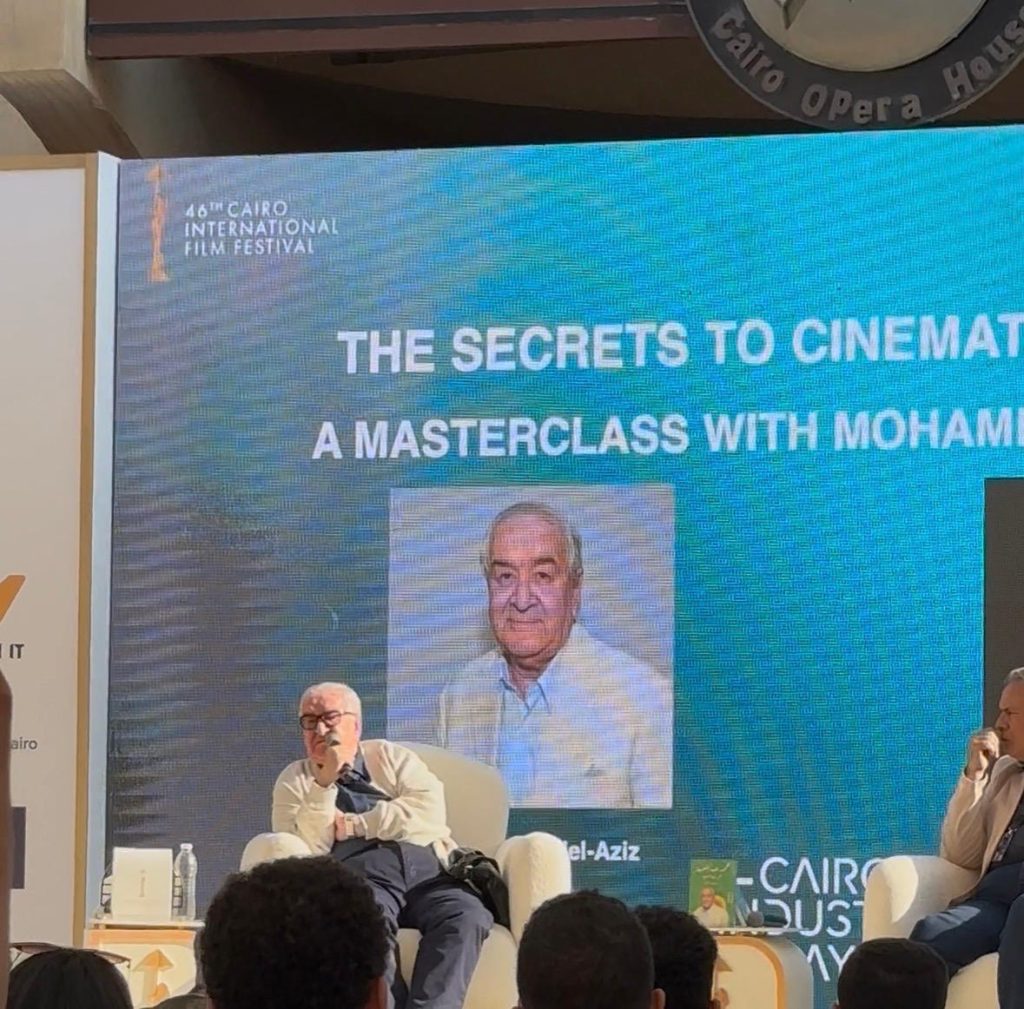
We were about to learn from a man who didn’t just make comedies—he redefined them. Mohamed Abdel Aziz spoke not about jokes, but about life, art, and the responsibility of laughter. For decades, he has been a towering figure in Egyptian cinema, but hearing him explain his craft made me realize why his films endure: because they are built on truth. “Comedy is not an escape; it’s a lens to confront reality.” That sentence explains why his films—Khally Balak Men Giranak, Hanafy El-Obaha, Fi El Seif Lazem Neheb—are more than entertainment. They function as social mirrors, reflecting contradictions with warmth and irony. Abdel Aziz doesn’t use humor to soften reality; he uses it to expose it.
His philosophy is rooted in respect—for the audience, for the craft, and for life itself. He believes laughter should provoke thought or reflect reality with all its elements of a time and place and of course amuse. “Don’t fear comedy—it’s the heartbeat of cinema,” he told us. Humor bridges divides, humanizes flaws, and invites reflection without cruelty. He rejects the idea that drama is superior to comedy; in fact, he believes the opposite. “Comedy is more expressive than drama because through it, you can address the most challenging topics,” he said. Comedy is a powerful instrument—a genre capable of piercing through taboos and social barriers with grace.
What struck us most was his commitment to situational comedy. Abdel Aziz avoids cheap gags and exaggerated caricatures. Instead, he builds humor from real-life dilemmas: a meddling neighbor, the absurdity of bureaucracy, the tensions between generations. the essence of comedy lies in the tension between expectation and reality. When life surprises us, laughter becomes inevitable. When you think of it comedy is somehow like music, every beat matters. timing, pauses, and reactions are instruments. A glance held for a second too long, a line delivered half a beat late—these micro-moments create rhythm. And we can see that in Abdel Aziz’s films they often start in simplicity, escalate into chaos, and resolve with a moral undertone, leaving audiences laughing and thinking long after the credits roll.
From his masterclass, we gathered principles that feel like commandments for any filmmaker. Comedy begins with deep observation, in real stories—your own and those around you. Strong characters matter more than punchlines; humor should emerge naturally from personality. Irony must be balanced with empathy so that audiences laugh without feeling that a character is being humiliated. Confidence and resilience are essential.
His brilliance shone through his collaborations with Egypt’s biggest stars. Adel Imam’s charisma turned social satire into box-office magic. Lebleba brought charm and emotional depth. Ilham Shahine added strength and gravitas and Samir Ghanem’s improvisational genius blended seamlessly with Abdel Aziz’s structured vision.Together, they created what many consider the golden age of Egyptian comedy—films that still echo in the culture today.
As we listened, we couldn’t help comparing his approach to pioneers like Salah Abu Seif and Ali Badrakhan. Abu Seif dissected society with realism; Badrakhan used political melodrama. Abdel Aziz inherited their devotion to truth but wrapped it in humor, making his critique palatable without losing its sharpness. Where others sought catharsis through tragedy, he offered redemption through laughter. This choice made his films accessible yet profound, inviting audiences to think without feeling weighed down.
What truly sets Abdel Aziz apart is his resilience. His belief in comedy as an art form paved the way for generations of filmmakers who use satire and irony to comment on society today. When he insisted that his students submit comedy projects, it wasn’t a whim—it was a call to preserve cinema’s beating heart. His influence continues to shape young directors who experiment with humor as a tool for truth.
His career milestones tell the story of a man who evolved with cinema while maintaining his unique voice. His 1972 debut, Forbidden Images, was among the last black-and-white Egyptian films. By 1974, Fi El Seif Lazem Neheb had introduced a romantic comedic tone that would define much of his work. In 1978, he delivered a sharp satire on marriage and bureaucracy in Al-Baadh Yathhab Lil Maathoun Maratain. The 1980s and 1990s saw unforgettable collaborations with Adel Imam—Khally Balak Men Giranak, Hanafy El-Obaha—which cemented his reputation as the master of social comedy. His contributions extended to theatre, with plays like Street Mohamed Ali, and to television, with series such as Abu Dehka Genan.
After hours of listening, reflecting, and revisiting his words, we realized that the secret of cinematic comedy lies in confidence, resilience, and authenticity. Comedy thrives on observation and courage—the courage to laugh at life without trivializing it. Abdel Aziz taught us that the greatest laughs often spring from the deepest truths and that the approach to comedy not just because it generate laughs and giggles it should be taken lightly, it requires all the seriousness and commitment to deliver a work that resonates and lasts a life time. His films remind us that humor is not a detour from reality—it is reality, seen through a sharper, kinder lens. And that, perhaps, is why Mohamed Abdel Aziz remains not just a filmmaker, but a philosopher of laughter.