

Die My Love follows Grace, a once-driven writer and new mother who moves with her husband to a remote rural town. They hope the quiet will fix what exhaustion and ambition burned out. Instead, the silence turns into a mirror she can’t escape. Motherhood feels like a sealed room closing in. The film pulls the audience inside her collapsing mind until memory, fantasy, and reality blur together. It is less a story and more a mental state, and the goal seems to be making you feel it instead of making you understand it.
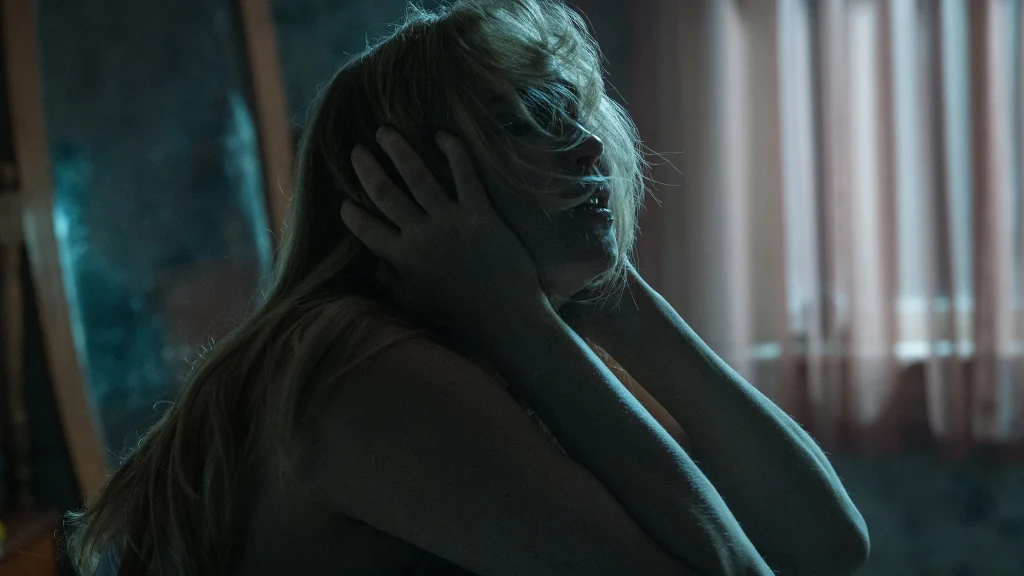
From the first frame, the intensity hits hard. The aspect ratio squeezes the image like a fist. The color looks washed out to the point of discomfort. The texture of the image feels rough, almost like mental sandpaper on the lens. The camera isn’t watching. It’s trapping. Angles box characters in like there’s no air. The visual language is confinement, and the audience feels it just as much as Grace.
But that approach cuts both ways. The shaky handheld shots, the jittering focus, the harsh lighting, all of it clearly reflects her instability. It mirrors panic and a body out of rhythm with itself. The idea makes sense. The experience hurts. What should feel like emotional chaos eventually turns physically overwhelming. Instead of pulling you deeper, it wears you down. At points it stops feeling symbolic and just feels like an actual headache.

The editing jumps from moment to consequence without the bridge in between. Sometimes this is brilliant. Certain transitions feel like a memory glitching or misfiring. But the film never gives the viewer a foothold. Scenes shuffle like cards with no rhythm or pause to regain balance. The sound design joins the onslaught. Dogs bark and howl endlessly. Yes, it adds to the suffocating world at first. Then it becomes too much, more irritation than expression. What starts as a stylistic choice turns into noise that keeps pushing you away.
Jennifer Lawrence’s performance is raw, devoted and physical. Grace does small, strange things that show her unraveling: sitting inside a fridge just to feel cold, licking glass like she’s testing the world by touch, repeating a word to anchor herself, dancing until it becomes robotic, drifting in and out of awareness. These moments are striking. The editing reinforces her loop. But the emotional tone barely moves from repeating and lingering more. It starts at collapse and stays there. With no rise or fall, that level of devastation loses dimension.
And that’s the heart of the issue. There’s no room to breathe. No quiet before the storm. No clarity to make the breakdown hit harder. It’s all breakdown, all storm, from start to finish. Without vulnerability or contrast, the audience is being asked to connect with a scream instead of a voice. The result is distance. You watch her suffering instead of entering it.
The film is clearly about postnatal depression, and that matters. It deserves to be explored. But the surrealism that tries to show psychological truth ends up pushing the viewer away. We see the behavior and the fallout, but not the emotional interior that makes it human. The film wants us to feel her pain, but it doesn’t open a door for empathy. It asks for connection without offering a way in.
Lynne Ramsay is a gifted filmmaker, and her talent is visible throughout. We know what she can do from You Were Never Really Here, where trauma and narrative blur but still hold emotional weight. Here, that same confidence feels scattered. What once felt sharp now feels chaotic. Immersion turns into erosion. The ambition is obvious, but the execution feels like being held underwater with no promise of when you can come up for air.
In the end, Die My Love is the kind of film that divides people. It’s bold, immersive, visually confident, and completely committed to its vision. It’s also exhausting, alienating, and emotionally locked. It doesn’t guide you through a descent. It throws you into one and dares you to survive it. There is real power in that. But power without balance goes blunt. By the time the credits roll, it stops feeling like a film and starts feeling like a test of endurance.
A story about losing yourself should feel unclear at times. That makes sense. But clarity is what the audience needed to care. Without it, the emotional bridge breaks. You don’t leave devastated. You leave drained. Not connected to Grace, but relieved it’s finally over.