
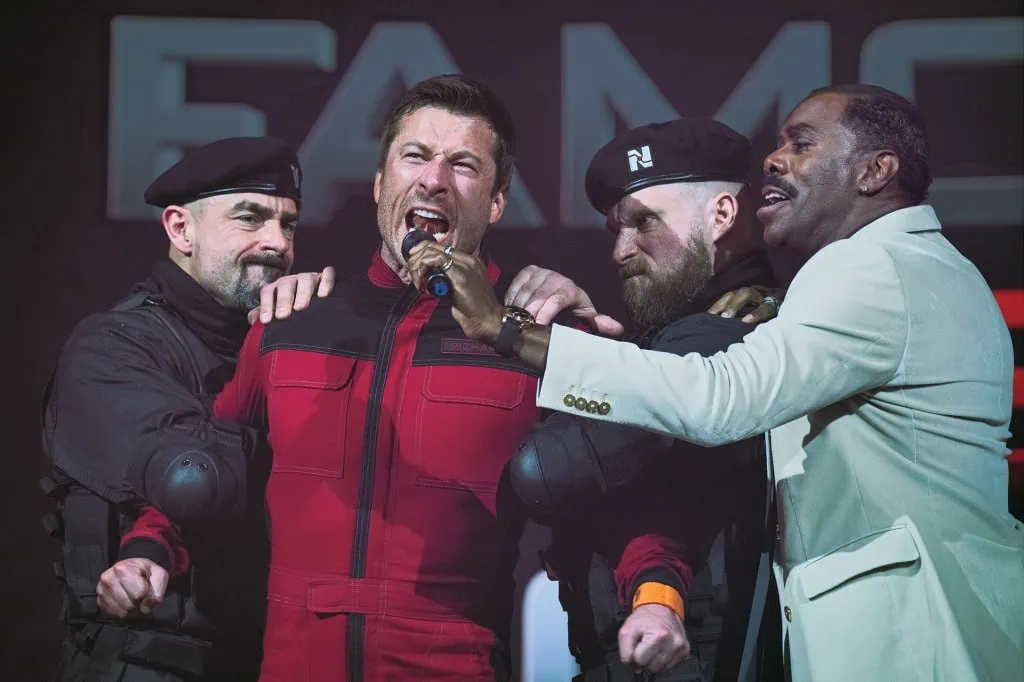
Stephen King has been on a surprisingly strong cinematic streak lately. Not just in terms of how many adaptations are coming out, but in how well they’re actually working. These films aren’t something audiences are sitting through out of loyalty anymore people are genuinely responding to them. The Running Man arrives right in the middle of that momentum, and it feels less like another dip into King’s archive and more like a reset. A reminder that his dystopian ideas still hit hard when they’re treated seriously and not dressed up as empty spectacle.
With Edgar Wright in the director’s chair, this new version finally embraces what The Running Man was always supposed to be. It’s not a shiny action showcase built around muscle and explosions. It’s a survival story with teeth, wrapped in entertainment, and pointed directly at a society obsessed with watching people suffer for fun.
Wright clearly respects King’s original novel, and that respect shapes the entire film. Sometimes it works in the movie’s favor. Other times, it holds it back.
The story takes place in a future split cleanly between comfort and desperation. The wealthy live behind protected walls, while everyone else survives in the shadows, scraping by under a system that doesn’t care if they make it. Ben Richards, played by Glen Powell, isn’t a superhero or a rebel icon. He’s a regular guy pushed to the edge, forced into The Running Man, a brutal televised competition where survival itself is the entertainment.
The rules are simple and merciless. Every decision matters, every mistake costs something, and the cameras never stop watching. Richards has to rely on his instincts, his intelligence, and whatever strength he can summon just to stay alive. The game moves fast, constantly throwing new threats in his path, but it also highlights how people adapt when the odds are stacked completely against them.
What gives the film weight is how tightly the world is constructed. The divide between the polished city and the surrounding slums isn’t just background detail. It drives the story. The system makes sense in a disturbing way, and once the rules are set, the film sticks to them. There’s no bending logic just to get characters out of trouble. That clarity allows the movie to move quickly without stopping to explain itself every few minutes, and audiences responded well to that confidence.
This sense of order and cruelty comes straight from King’s original idea, and Wright’s decision to preserve it instead of softening it is one of the film’s smartest choices.
Wright’s direction shines most in how the film moves. The action is clean, well-planned, and easy to follow. Scenes rarely feel messy or thrown together, and there’s a constant sense of momentum pushing everything forward. At the same time, that commitment to the book’s structure creates problems near the end. The final stretch feels rushed, not because it’s poorly made, but because too much is packed into too little time.
Ironically, the film’s loyalty to the novel becomes a double-edged sword. What reads well on the page doesn’t always breathe the same way on screen. A few moments needed either more room to settle or a sharper trim earlier on to keep the pacing even.
Visually, the film stays engaging throughout. The editing is energetic without becoming overwhelming, and the cinematography balances sleek production with rough edges. There’s a sense that everything has been polished for broadcast, even as real pain plays out underneath. Some viewers picked up on a subtle comic-book rhythm in how scenes are staged and cut, not in a flashy way, but in how movement and timing carry the story. That style keeps the film watchable even when the narrative briefly loses steam.
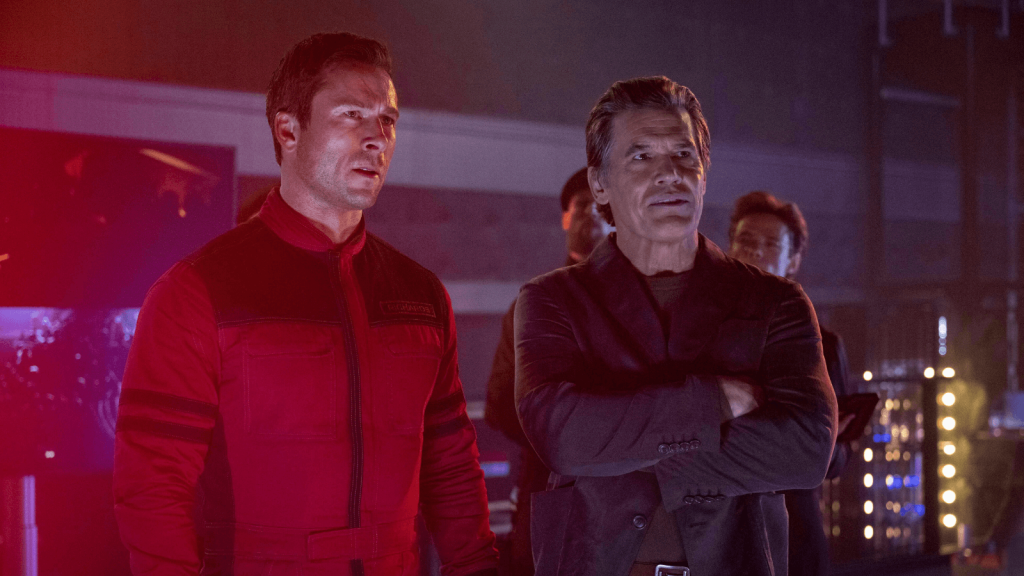
The performances help hold everything together. Glen Powell proves to be a strong choice for Richards, bringing both physical presence and emotional grounding. He plays the character as a man driven by responsibility and fear, not ego, which makes the danger feel more real. Josh Brolin stands out as well, delivering a cold, controlled performance that captures institutional cruelty without slipping into cartoon villainy.
The supporting cast adds variety and texture. Colman Domingo and William H. Macy bring warmth and weight to their roles, helping the film feel human even in its harshest moments. Michael Cera’s performance divided audiences. Some enjoyed the tonal shift he brings, while others felt it briefly pulled them out of the story. Still, even the more debated choices feel intentional rather than careless.
Given Edgar Wright’s reputation, the film’s humor was always going to be closely watched. It’s there, but it’s restrained. This isn’t a rapid-fire comedy packed with big laughs. The humor mostly shows up through media satire and uncomfortable irony, especially in how the show treats human suffering as content. That approach worked for many viewers, even if others expected sharper comedic highs.
Where the satire really lands is in its take on reality television and spectacle culture. The film doesn’t shout its message, but it doesn’t hide it either. Watching people compete, suffer, and die for ratings feels uncomfortably close to the world we already live in, which gives the story its edge.
The split between critics and audiences makes sense. Critics tended to focus on pacing issues and missed opportunities for deeper emotional exploration. Audiences, meanwhile, leaned into the film’s energy, performances, and fully realized world. For many viewers, it succeeds simply by knowing what it wants to be and executing it with confidence.
Comparisons to stories like The Hunger Games, Squid Game, Gamer, and even King’s own The Long Walk are unavoidable. What sets The Running Man apart is its urgency. This isn’t about slow rebellion or drawn-out misery. It’s about constant movement, relentless pressure, and a system that feeds on desperation. Even when the structure strains, the film rarely loses that sense of drive.

In the end, The Running Man isn’t perfect. The pacing tightens unevenly, the humor won’t work for everyone, and its faithfulness to the novel sometimes limits its flexibility. But those flaws come from discipline, not confusion.
What Edgar Wright delivers is a focused, energetic adaptation that understands the world it’s portraying and trusts the audience to keep up. It values momentum over excess and clarity over noise. For Stephen King fans, it’s the most satisfying version of this story so far. For action fans, it’s a sharp, engaging ride. And for anyone paying attention, it’s a reminder that dystopia doesn’t need to be exaggerated to feel real. It just needs to be recognized.
Please let me know if you’re looking for a writer for your
site. You have some really good articles and I think I would be a
good asset. If you ever want to take some of the load off, I’d really like
to write some articles for your blog in exchange for
a link back to mine. Please shoot me an e-mail if interested.
Thanks!